
A website that looks fine but brings in no calls is not a bargain. For Australian business owners weighing up a website builder versus developer, the real question is not simply, “What costs less?” It is, “What will help my business get found, earn trust and make it easier for customers to contact us?”
A do-it-yourself builder can get a basic site online quickly. A professional developer or agency can create a more tailored digital asset with strategy behind it. Neither option is automatically right for every business. Your budget, time, growth plans and willingness to handle the technical bits all matter.
The website builder versus developer decision is bigger than design
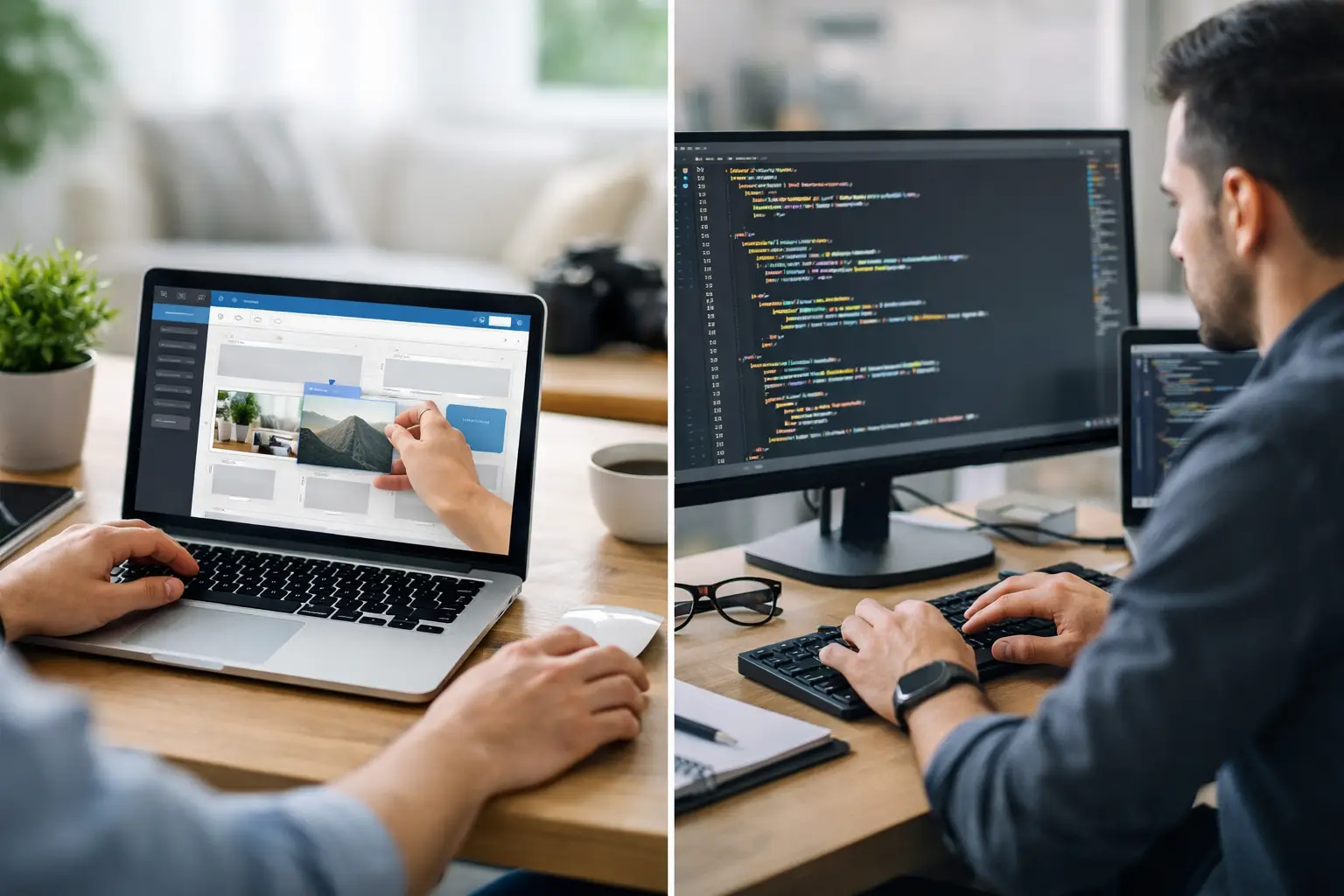
Website builders are platforms that let you create a site using pre-made templates and drag-and-drop tools. They are built for speed and accessibility. You pick a layout, add your copy and images, connect a domain, then publish.
A developer builds or configures a website around your specific requirements. That may involve custom design, more flexible functionality, conversion-focused page structures, technical SEO, hosting setup and ongoing support. You are paying for expertise as well as the website itself.
The key difference is ownership of the workload. A builder gives you the tools. A developer gives you a person or team to make the decisions, do the work and help keep the site moving in the right direction.
For a sole trader with a simple service offering and plenty of spare time, a builder may be a sensible starting point. For a growing trade business, medical practice, retailer or professional service firm, a site usually needs to do more than display a phone number. It needs to support enquiries, local search visibility, campaigns and credibility.
When a website builder makes sense
A website builder can be a good fit when your website requirements are genuinely simple. Perhaps you need a small online brochure for a short-term project, a basic portfolio, or a landing page to test an idea before spending more.
The upfront price is appealing. Most builders charge a monthly or annual subscription, and you can make edits whenever you like. Adding a new staff photo, changing trading hours or posting a quick update does not require waiting for someone else.
That flexibility does come with a catch. You are responsible for the copy, images, page layout, mobile presentation, search settings, forms, updates and troubleshooting. A template may look sharp in a demo, but it will not automatically suit your business once real content, customer questions and service details are added.
There is also the time factor. Business owners often begin with good intentions, then find themselves working on the site after hours for weeks. The job becomes one more thing sitting on the to-do list, alongside quoting, payroll and serving customers.
A builder is best viewed as a tool, not a strategy. It can produce a capable website when used well, but it does not tell you which pages your customers need, what search terms matter in your area or where a call-to-action should sit to encourage enquiries.
Common builder pitfalls for small businesses
The most common issue is not that the platform is bad. It is that the site is built without enough commercial thinking behind it. Pages can become cluttered, generic or hard to navigate on mobile.
Businesses also tend to underestimate the ongoing jobs. Your domain needs renewing, forms need testing, software needs updating, backups matter and hosting performance can affect the customer experience. If someone searches for your business at 8 pm and the site is slow or broken, that lead may go to the next name on the list.
Then there is SEO. Most builders offer basic SEO fields, which is helpful, but filling in a page title is only one small part of getting found. Local relevance, useful content, site structure, speed and clear service pages all play a role.
When working with a developer is worth it
A website developer is often the better option when your website must actively support business growth. That is especially true if you rely on enquiries, bookings, online sales, local search traffic or paid advertising.
A good developer starts with the customer journey. What does a visitor need to know before they call? Which services should be easiest to find? What proof will make them feel comfortable choosing you? The answers shape the site before a colour palette or template is chosen.
Professional development also gives you more room to tailor functionality. You may need quote request forms that capture the right job details, online bookings, product filters, integrations with business systems, location pages or a content area your team can update. A template can sometimes handle these needs, but it may become awkward as your business grows.
You also gain accountability. If there is a problem with email forms, hosting, mobile display or a campaign landing page, you have someone who understands the setup and can help sort it out. For busy owners, that support is often worth far more than the initial build price.
At Catchy Pages, this approach means looking at the whole picture: website design, in-house SEO, managed Australian hosting and the marketing activity that gets people through the virtual door. A website should not be treated as a standalone brochure when it can be part of a stronger lead-generation setup.
The trade-offs of hiring a developer
A developer-led project costs more upfront than doing it yourself. It also requires some input from you. You will need to share your services, customer insights, brand preferences, photos, approvals and any compliance requirements. A quality website cannot be built properly in a vacuum.
Not every developer is the same, either. Some are excellent at code but less experienced with conversion copy, SEO or marketing. Others create beautiful visuals but leave clients to arrange hosting and ongoing maintenance elsewhere. Ask what is included and who handles the work after launch.
The goal is not to pay for custom features you do not need. It is to invest in the pieces that remove friction for your customers and save time for your team.
Compare the cost beyond the first invoice
A website builder appears cheaper because the initial outlay is low. That may be true, particularly for a very small site. But compare the full cost over time, including your own hours.
If you spend 30 or 40 hours learning a platform, writing pages, resizing images and repairing formatting, that time has value. So does a lost enquiry caused by a vague service page or a form that is not working properly.
A developer has a higher upfront cost, but the project may include planning, professional copy guidance, mobile optimisation, SEO foundations, domain setup, hosting and ongoing care. Those inclusions can make the investment easier to justify because fewer loose ends are left on your desk.
There is no need to overspend before the business is ready. A simple, professionally planned five-page site can outperform a large, expensive website full of pages no customer reads. Start with the priorities, then build room to expand.
Questions to ask before you choose
Be honest about what your business needs over the next 12 to 24 months. If you can confidently answer yes to several of these, a professional developer or agency is likely the more practical choice:
- Do you need the website to generate regular leads or bookings?
- Will customers search for you on mobile, especially in your local area?
- Are you planning SEO, Google Ads, social advertising or email campaigns?
- Do you need help with copy, branding, hosting or technical support?
- Would a broken website or missed enquiry cost you real revenue?
On the other hand, a website builder can suit you if the site is temporary, very simple, not central to sales, and you are comfortable taking responsibility for setup and maintenance.
A middle ground can be the smart move
This does not always have to be a strict choice between a fully DIY template and a massive custom project. Many small businesses get the best result from a professionally built website on a user-friendly platform.
You receive a clear layout, credible design, strong service pages and the technical foundations handled for you. Once the site is live, you can still make straightforward updates if that suits your team. It is a practical balance between control, affordability and expert support.
This option works particularly well for businesses that want to get online quickly without looking like they rushed it over a Sunday afternoon. It also leaves a solid base for future SEO, paid campaigns and content when you are ready to grow.
Choose the option that gives your business momentum
The best website is not the one with the most features or the cheapest monthly fee. It is the one that makes it easier for the right customers to find you, understand what you offer and take the next step.
If a builder gets you started without draining your time, use it with a clear plan. If your website needs to carry more of the sales and marketing load, bring in a team that can handle the technical work while you get on with running the business. A few well-made decisions now can save plenty of patch-up work later.